Column by the President of Hitachi Research Institute, Mizoguchi
The changes brought about by the evolution of AI have been astonishing. Students use AI in writing academic papers. Robots now perform backflips and dance routines better than humans. AI instantly identifies bombing targets and plays a leading role in warfare. Product placement in convenience stores is carried out by humans following AI-generated instructions. Security vulnerabilities in existing systems are rapidly detected by AI, while romance scams using AI-generated images are surging. Looking ahead, scientific progress may accelerate explosively through AI. The argument that AI is merely a bubble now belongs to the past. It increasingly appears that AI will either recreate the world, destroy it, or perhaps do both. The key requirements for realizing this future are computing power, the semiconductors that make such computing possible, and the energy supply needed to sustain them. The combined market capitalization of publicly listed companies worldwide is approximately $150 trillion, of which AI-related companies already account for more than 20 percent. Within that segment, semiconductors alone represent nearly 10 percent. AI is growing with a momentum akin to a dragon soaring into the heavens.
Global stock markets are also heavily shaped by political developments. The February 28 attack on Iran by U.S. and Israeli forces was not anticipated by the markets. Some observers expected a swift conclusion to the operation, similar to what had been achieved in Venezuela, following large-scale airstrikes and the killing of numerous senior leaders, including Supreme Leader Ayatollah Khamenei. However, on March 4, Iran’s Revolutionary Guard declared the closure of the Strait of Hormuz. The prospect of a global energy crisis sent shockwaves around the world. The S&P 500 fell sharply toward the end of March, reaching its lowest level of the year on March 30. Markets were further unsettled by President Trump’s inflammatory rhetoric, including remarks about “sending Iran back to the Stone Age.” Yet following a provisional ceasefire agreement between the two sides on April 7, stock prices rebounded sharply. The S&P 500 closed above the 7,000-point threshold for the first time in history. Markets appeared energized by what came to be called the “TACO(Trump Always Chickens Out)” trade. At the same time, some argued that the risks had not been fully priced in, since the closure of the Strait of Hormuz remained unresolved. This view was captured by the phrase “NACHO” (Not A Chance Hormuz Opens). Uncontrollable geopolitical tensions resemble a dragon raging through stormy skies.
Another destination for the rapidly expanding flow of capital amid recent international tensions is defense spending. Global military expenditures have risen by roughly 40 percent over the past decade, reaching $2.89 trillion in 2025. Given deteriorating security environments across regions, military buildups by major powers, and growing pressure on middle powers to strengthen their own defenses, military spending is likely to continue rising in the years ahead. The defense industry is experiencing accelerated growth, and the stock prices of related companies have surged. The stock price of Rheinmetall, Germany’s largest defense company founded in 1889, has increased by 1,300 percent, while Japan’s Mitsubishi Heavy Industries has seen its stock price rise tenfold over the past five years. Defense stocks were traditionally categorized as value stocks, but investors now increasingly treat them as growth stocks. The growing importance of national security and the inflow of investment capital into the defense sector are also reshaping the nature of dual-use technologies. As seen with AI and drones, cutting-edge technologies are increasingly developed with dual-use applications in mind. This allows enormous public and private resources, including talent, materials, and capital, to be directed toward them, accelerating the pace of development and expanding the range of applications. The dual-use market is emerging as a new ecosystem tied directly to national survival.
No place illustrates the combined impact of AI and shifting geopolitical dynamics more clearly than Taiwan. Taiwan’s stock market capitalization has surpassed that of India, making it the fifth largest in the world, due overwhelmingly to the contribution of TSMC. With a market capitalization of roughly $2 trillion, TSMC accounts for more than 40 percent of Taiwan’s total market capitalization. Globally, it ranks around seventh or eighth, and it is the largest company in Asia. TSMC is responsible for the near-monopolistic production of the world’s high-performance AI chips. In advanced miniaturization technologies, it remains one to two generations ahead of competitors. By maintaining high barriers to entry through massive capital investment and long development timelines, the company has positioned itself to generate enormous cash flows for years to come. Against the backdrop of changing security conditions, Taiwan’s defense spending has reached record highs every year since 2018. The 2026 budget allocates NT$949.5 billion, representing a 23 percent increase year-on-year and exceeding 3.2 percent of GDP. Furthermore, the Lai administration has announced plans to raise defense spending to 5 percent of GDP by 2030. It would not be an exaggeration to say that AI and geopolitical developments will determine Taiwan’s fate.
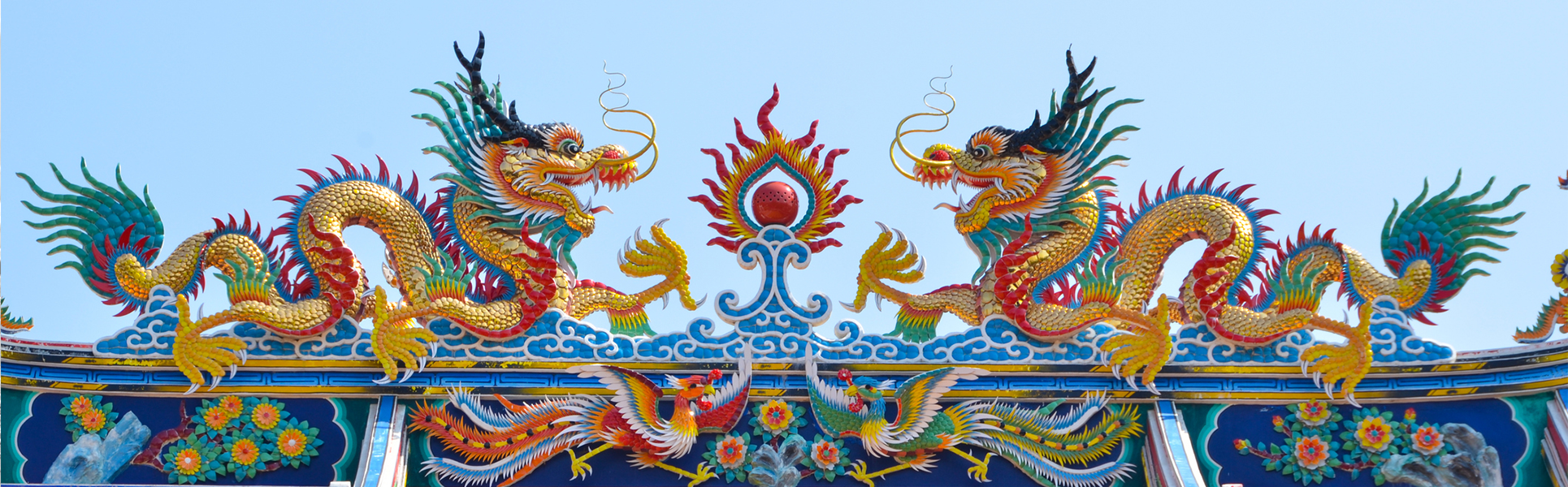
In Chinese tableware and temple decorations, one often encounters an image of two dragons encircling a round jewel. Known as “双龍戯珠” (Shuānglóng Xì Zhū, “Two Dragons Playing with a Pearl”), it is considered an auspicious motif in which the two dragons either compete over or play with a sacred pearl. Driven by the twin dragons of AI and geopolitics, will Taiwan, and indeed the world, ride an upward current toward ever greater heights? Or are we simply being tossed about, uncertain of where events may lead? The I Ching also contains the teaching “亢竜有悔” (kōryū yūkai, “The Arrogant Dragon Will Have Cause to Regret”. It warns that once a dragon has ascended to the highest point, there is nowhere left to go but down, and that the height of prosperity inevitably marks the beginning of decline. How high can the dragon of AI continue to rise? Will the other dragon, geopolitics, clash with the AI dragon or cooperate with it? For some time to come, it seems that we are likely to witness a drama of immense consequence.
We provide you with the latest information on HRI‘s periodicals, such as our journal and economic forecasts, as well as reports, interviews, columns, and other information based on our research activities.
Hitachi Research Institute welcomes questions, consultations, and inquiries related to articles published in the "Hitachi Souken" Journal through our contact form.