Mar. 26, 2026
Previously, manufacturing industries globally dispersed their value chains in pursuit of efficiency gains and productivity improvements. In recent years, however, natural disasters and rising geopolitical tensions have caused value chains to stagnate and fragment, leading to recurring supply shortages. As vulnerabilities stemming from globally distributed production networks have become increasingly apparent, governments and corporations across countries and regions are advancing initiatives to reshore and regionalize manufacturing activities. Notably, as part of these efforts, the intrinsic value of manufacturing itself is being reassessed. Capital expenditure focused on production capabilities, as well as investments in digital technologies, is expanding. In coordination with upstream and downstream segments of the value chain, firms are seeking to transform how value is created. Hitachi Research Institute (HRI) is conducting research on the emerging model of what may be termed next-generation manufacturing or “Neo Manufacturing” through which the manufacturing sector can realize new forms of value creation.
In recent years, the global environment has become increasingly unstable due to rapid geopolitical shifts and the growing frequency of natural disasters. With respect to geopolitically driven changes, governments across countries and regions have designated the securing of strategic materials—such as rare earth elements, semiconductor materials, steel, and aluminum—as key policy priorities. As export controls and related measures have been strengthened to secure and ring-fence these strategic resources, prices for these materials have risen sharply (Figure 1).
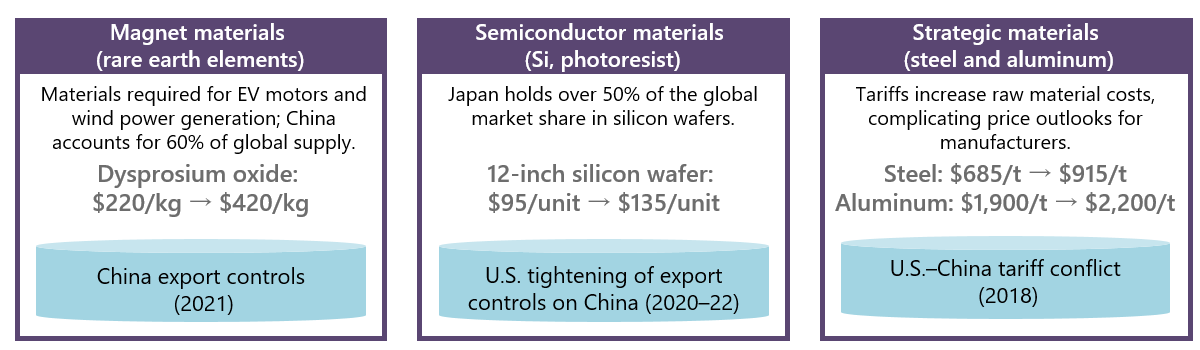
Note: "→" (arrow) indicates price changes before and after each event.
Source: Prepared by HRI from various materials
Figure 1. Price fluctuations in critical resources associated with geopolitical risk
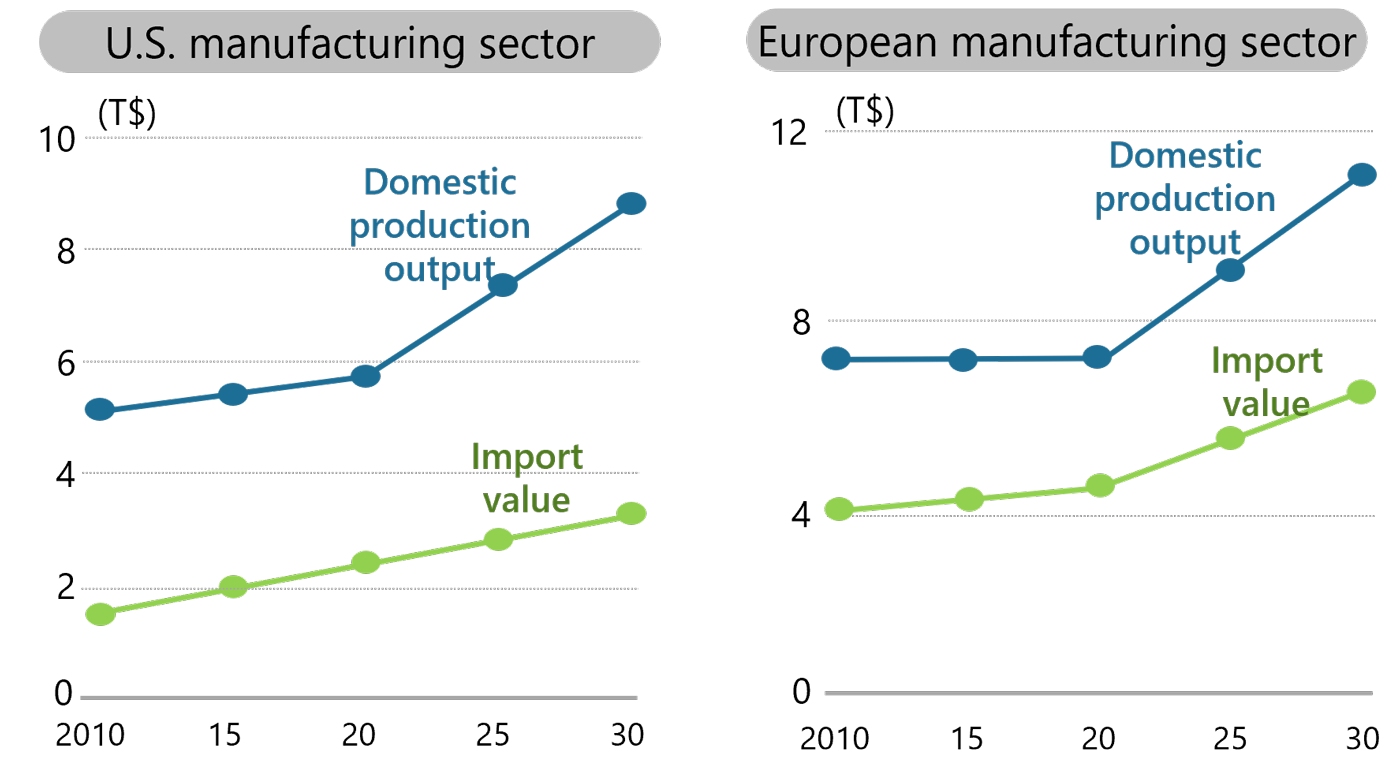
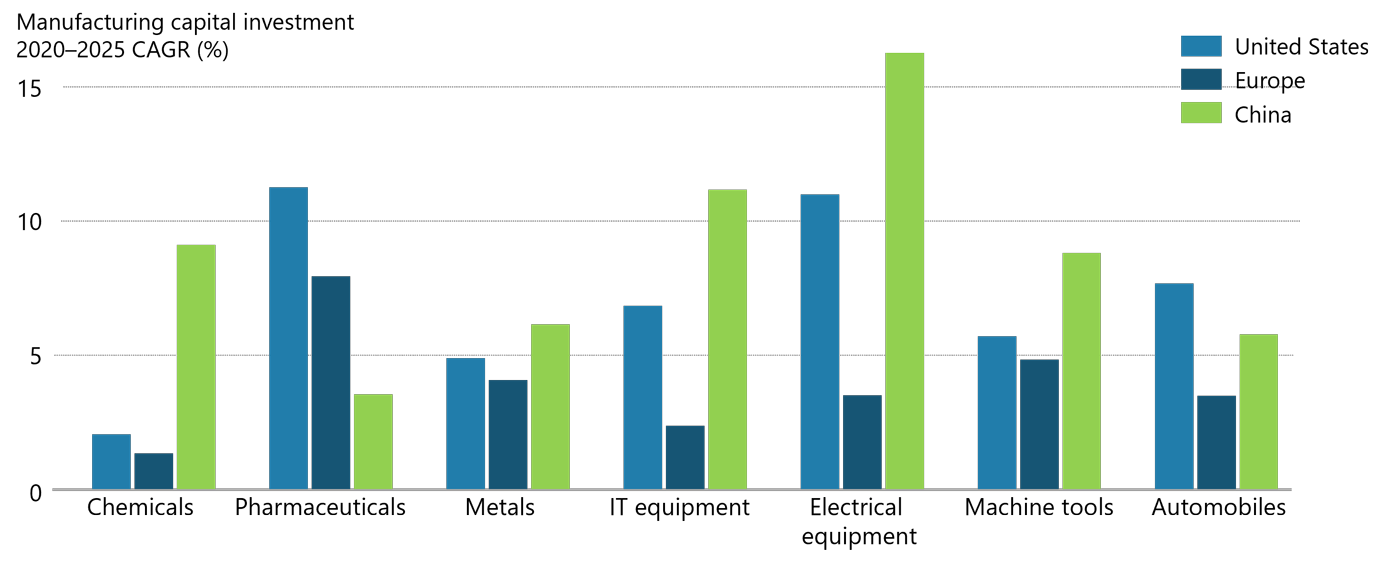
Manufacturing industries have historically pursued efficiency by globally dispersing their value chains. However, as the global environment has become increasingly unstable, vulnerabilities in these value chains have become more pronounced, including difficulties in securing resources and components. As part of countermeasures, manufacturing firms are accelerating efforts to reshore and regionalize production. As shown in Figure 2, in the United States and Europe, domestic manufacturing output has grown markedly relative to import levels, suggesting a trend toward domestic and intra-regional realignment. In parallel, capital investment in manufacturing is increasing across countries and regions. As illustrated in Figure 3, the United States—driven by considerations of national security and strengthening national capabilities—is prioritizing pharmaceuticals, electrical equipment (energy), advanced IT equipment, and the automotive sector. Europe is likewise expanding investment, particularly in pharmaceuticals. Meanwhile, China, aiming to establish itself as a leading manufacturing power, is not only investing in advanced IT equipment but is also intensifying investment in core industrial sectors such as electrical equipment (energy) and chemicals.
Source: Prepared by HRI from various materials
Figure 2. Trends in manufacturing production output in the United States and Europe
Source: Prepared by HRI from various materials
Figure 3. Increase in manufacturing capital investment by industry in the United States, Europe, and China
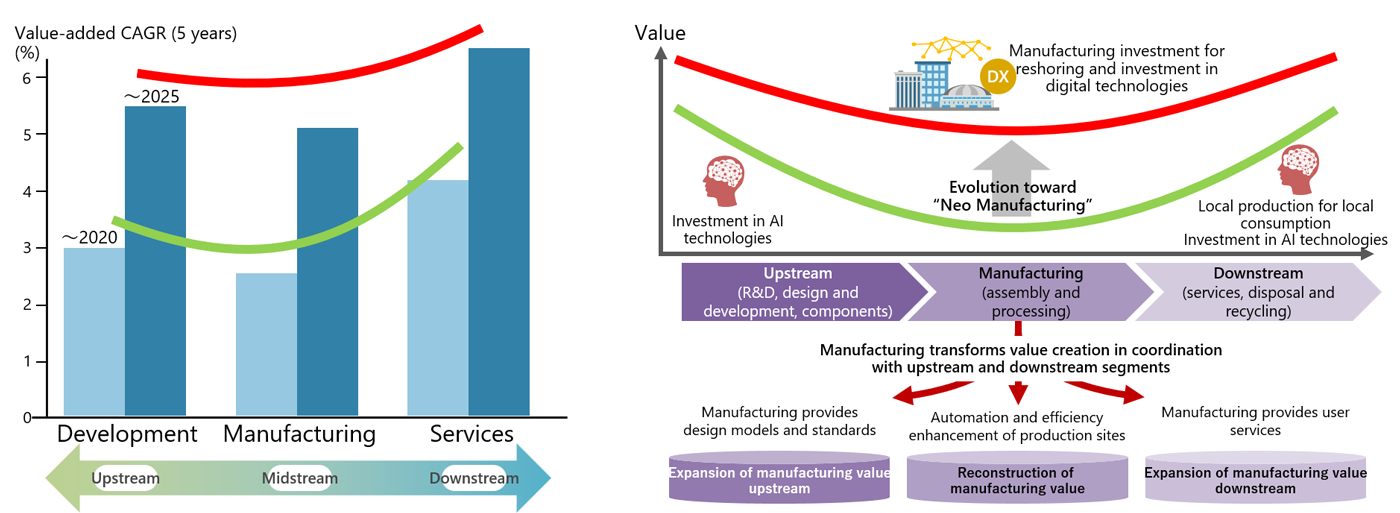
The changes observed in the manufacturing sector are not limited to capital investment associated with reshoring. It is also important to note that productivity has improved as a result of advances in AI, digital technologies, robotics, and automation technologies. Consequently, the value structure of the manufacturing value chain is undergoing transformation. Figure 4 (left) compares value-added growth rates across the upstream (development), manufacturing, and downstream (services) segments of the value chain over two five-year periods: up to 2020 and up to 2025. As shown in Figure 4 (right), the “smile curve,” which represents the value structure, has exhibited a flattening trend in recent years.
Chapter 2 examines the emerging form of manufacturing that is driving these changes in the value structure.
Source: Prepared by HRI from various materials
Figure 4. Changes in value-added growth rates across the manufacturing value chain (left) and transformation of value creation through "Neo Manufacturing" (right)
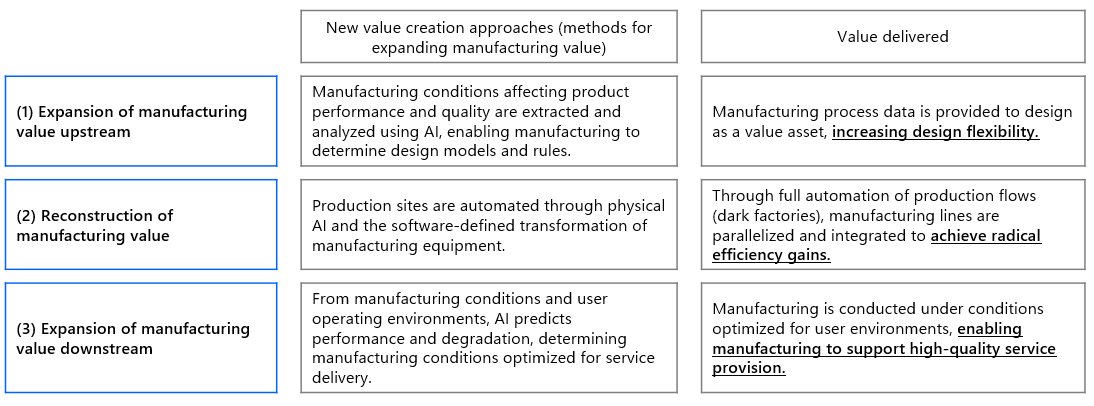
Amid changes in the global environment, manufacturing is transforming the way it creates value, resulting in a flattening of the value-chain smile curve. Specifically, manufacturing firms are internalizing value across the value chain through the following three approaches (Figures 4 [right] and 5):
Manufacturing conditions related to quality are digitized using AI and fed back into design processes, thereby improving product quality and yield. Production-site data is becoming indispensable for upstream design and development.
Example: In semiconductor manufacturing, the Manufacturing for Design (MFD) approach is being adopted, whereby AI extracts manufacturing and environmental conditions affecting semiconductor chip quality to support design optimization. Information related to manufacturing processes is converted into Intellectual Property (IP) and shared with design partners.
Manufacturing processes are automated and unmanned through physical AI, as exemplified by “dark factories.” By parallelizing and consolidating production flows, inefficiencies are eliminated.
Example: In IT equipment manufacturing, fully autonomous factories have been established through the use of physical AI. By eliminating the presence of human workers and designing space and production lines without constraints related to human labor, productivity has been dramatically improved.
Operational status, user environments, and product performance are traced, and AI-based predictive feedback is applied to align manufacturing with user needs. This reduces rework such as defective product recalls. Similarly, AI-based prediction and improvement of quality defects within manufacturing processes shortens lead times from design to inspection. By embedding user needs into products, manufacturing integrates service functions into its value creation.
Example: In the biopharmaceutical sector, Real World Data (RWD), including clinical data, is analyzed to determine optimal pharmaceutical conditions tailored to individual patients. By predicting drug responses and efficacy at the time of administration, patient-specific optimized treatment can be delivered.
Source: Prepared by HRI
Figure 5. New value creation in manufacturing
What is common across these new forms of value creation in manufacturing is the extraction and analysis of on-site data through the application of AI. In essence, manufacturing is advancing a transition toward a data- and AI-intensive industry, or what may be described as Neo Manufacturing.
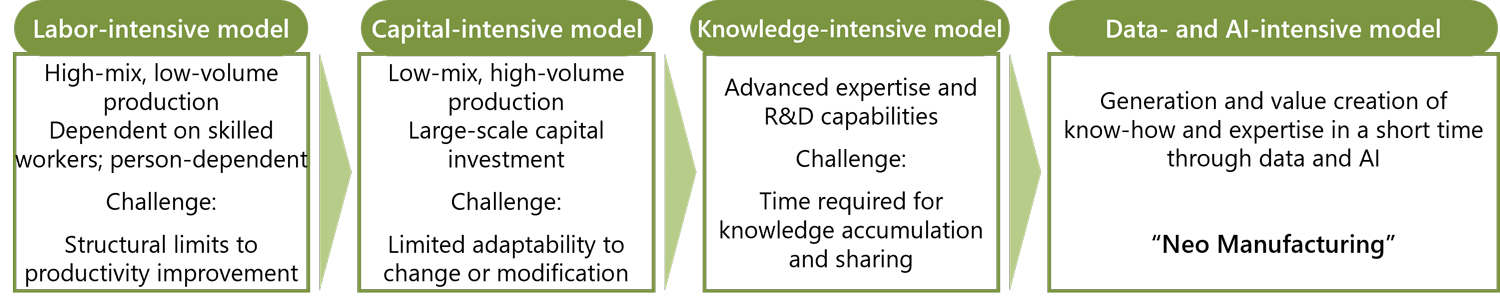
Looking back at the historical evolution of manufacturing, the early stage of industrial modernization was labor-intensive, with worker skill levels determining productivity; as a result, productivity improvements faced structural limits. This was followed by a capital-intensive phase, in which the introduction of machinery enabled mass production, but with limited flexibility in responding to changes in demand and the external environment. Manufacturing subsequently evolved into a knowledge-intensive model, dispersing value chains to enhance flexibility. However, in the current digital era, data often remains siloed within organizations, and the accumulation and sharing of knowledge and information require considerable time. As a result, the full benefits of digitalization have not yet been realized. Going forward, Neo Manufacturing, as it evolves into a data- and AI-intensive model, will enable the rapid generation and sharing of domain knowledge—including tacit know-how and expertise—through AI and data analytics. This will enhance resilience to environmental change and support the reshoring of production (Figure 6).
Source: Prepared by HRI
Figure 6. The evolution of manufacturing toward a data- and AI-intensive model
As manufacturing evolves toward a data- and AI-intensive model and undergoes structural transformation, this shift is being recognized as a new growth opportunity. In response, solution providers have emerged to support value creation in Neo Manufacturing. To reinforce the three transformations that contribute to flattening the smile curve, the following types of solutions are being offered:
(Strengthening process coordination from design to manufacturing)
Advanced digital twins enable real-time visualization and optimization of processes from design through production. Design optimization solutions originating from the manufacturing stage feed production data back into design models, thereby reducing design rework and improving overall efficiency.
(Process optimization through end-to-end integration of manufacturing workflows)
Solutions leveraging physical AI to control human-collaborative robots enable coordinated operations between humans and robots. These solutions establish new production processes and workflows in which humans and robots work together, automate non-routine tasks and multi-task operations, and support the sophistication and optimization of business processes.
(Connecting manufacturing and services through product lifecycle management)
Through real-time in-line quality inspection, manufacturing data is coordinated with after-sales service data, while data analytics solutions visualize yield and quality in real time. Solutions such as refurbishment determination utilize detailed internal state data captured during manufacturing for traceability management, improving degradation prediction accuracy and achieving significant reductions in disposal rates as well as more efficient resource circulation.
These solutions not only promote the application of data and AI across each process of the value chain, but also accelerate the evolution toward Neo Manufacturing by enabling effective integration and coordination between upstream, downstream, and manufacturing processes.
This study has examined the evolution of manufacturing and the transformation of its value structure in response to changes in the global environment, as well as the new forms of value creation realized by Neo Manufacturing. Neo Manufacturing flattens the smile curve that represents the value structure by expanding manufacturing value into upstream and downstream domains and thereby enhancing overall value. As a result, opportunities for value creation become more widely distributed and increase across the value chain. Going forward, we will continue research from the perspective of how manufacturing can capture and internalize this newly distributed value.
Hitachi Research Institute will continue to analyze the transformation of manufacturing in light of global environmental changes, while examining the future direction of manufacturing and the contributions that Hitachi can make.

Kazuyuki Fukuda
Senior Researcher, 2nd Research Department, Hitachi Research Institute
Seconded from Hitachi Systems Field Services and assumed his current position in 2024. His recent research focuses on technological and corporate trends related to green transformation (GX) in manufacturing, digitalization, and maintenance and operations services.

Daisuke Yasuda
Group Leader and Senior Researcher, Global Business Strategy Group, 2nd Research Department, Hitachi Research Institute
Engaged in research on digital policy and industry trends, as well as support for business strategy formulation. Prior to his current position, he worked at the National Institute of Advanced Industrial Science and Technology, the Ministry of Economy, Trade and Industry, and the Fraunhofer-Gesellschaft. His recent research focuses on AI and developments in rulemaking and corporate trends surrounding data.

Masayuki Miyazaki
Chief Researcher, 3rd Research Department, Hitachi Research Institute
Joined Hitachi, Ltd. and engaged in research and development in semiconductors, telecommunications networks, and IoT. After serving in the R&D Group, he assumed his current position. His current research themes include business strategy in manufacturing, as well as technological trends and technology strategy related to digitalization, biotechnology, security, and innovation.
Author’s Introduction
Kazuyuki Fukuda
Senior Researcher,
2nd Research Department
Daisuke Yasuda
Group Leader and Senior Researcher,
Global Business Strategy Group,
2nd Research Department
Masayuki Miyazaki
Chief Researcher,
3rd Research Department
We provide you with the latest information on HRI‘s periodicals, such as our journal and economic forecasts, as well as reports, interviews, columns, and other information based on our research activities.
Hitachi Research Institute welcomes questions, consultations, and inquiries related to articles published in the "Hitachi Souken" Journal through our contact form.