— Capturing Change and Translating It into Better Decision-Making —
Oct. 8, 2026
This report introduces the practice of economic analysis at Hitachi Research Institute (HRI). Through research and analytical activities, including economic forecasting, HRI continuously monitors and analyzes macroeconomic trends and structural changes in major countries and regions. Its analyses are developed by combining qualitative information on policy and geopolitics, objective economic and market data, and information closely reflecting conditions in the business world. HRI is also pursuing a range of initiatives to improve the efficiency of its analytical processes and the accuracy of its forecasts.
In recent years, uncertainty surrounding the global economy has increased significantly. The global pandemic, escalating geopolitical tensions centered on the U.S.-China strategic rivalry, wars in Ukraine and the Middle East, and the rapid adoption of AI and the uncertain trajectory of technological advances are all developments that are difficult to foresee based solely on conventional theories and past experience. Moreover, a wide range of factors, such as geopolitical risks, policy changes, and technological innovation, are affecting economic activity, making it increasingly important to analyze the channels through which these factors propagate and interact with one another. Against this backdrop, macroeconomic analysis requires a dynamic approach that can identify early signs of change and assess their impacts both logically and quantitatively.
Hitachi Research Institute (HRI) was established in 1973 as the in-house think tank of the Hitachi Group and has conducted research across a broad range of fields, including economics, society, industry, and technology. The Global Intelligence and Research Office also conducts agile analyses of important issues as they emerge, including structural changes in geopolitics, the economy, technology, and environmental and social conditions. In particular, its regular economic analyses, centered on quarterly macroeconomic forecasts, serve as a foundation for HRI’s research and analytical activities.
The purpose of this report is not to present a specific economic forecast or the results of an analysis of an individual theme. Rather, it aims to introduce HRI’s practical approach: how it identifies and interprets constantly changing global economic trends, what perspectives and questions it brings to bear, and what methods and processes it uses in its analyses.
Through research and analytical activities, including economic forecasting, HRI continuously monitors and analyzes macroeconomic trends and structural changes in major countries and regions. Specifically, its analyses are conducted in three steps.
An important challenge in the first stage of analysis is how to identify the essential signals (focus points) that may drive structural change from among the vast amount of macroeconomic data available.
At HRI, we continuously monitor economic statistics such as GDP, prices, employment, and trade in major countries and regions (the U.S., Europe, Japan, China, India, and APAC), as well as financial indicators such as exchange rates and stock prices and the monetary policies of major central banks. Through this ongoing monitoring, we detect changes in economic conditions that could significantly alter our assessment of the underlying trend, rising geopolitical risks, and signs of policy changes, and then narrow the scope of our analysis accordingly. For the focus points identified in this way, we formulate hypotheses concerning their underlying factors and transmission channels. We also identify factors that could cause economic forecasts, such as GDP growth rates, to exceed or fall short of expectations, as well as the potential for structural changes, thereby clarifying the issues that need to be examined.
Next, for the focus points identified, HRI adopts an approach that incorporates external qualitative insights and integrates them with internal quantitative analysis, thereby avoiding reliance solely on a particular theory or the subjective judgment of individual analysts.
Specifically, we regularly exchange views with leading overseas think tanks, including the Center for Strategic and International Studies (CSIS) in the U.S. and Chatham House (the Royal Institute of International Affairs) in the U.K., as well as with experts in Japan, to identify perspectives and scenarios concerning major global economic trends and geopolitical risks. At the same time, rather than accepting such qualitative insights at face value, we conduct analyses based on macroeconomic data, including official statistics and financial market data, in parallel, while also incorporating business-related information from within the Hitachi Group. By combining qualitative information on policy and geopolitics, objective economic and market data, and information closely reflecting conditions in the business world, we develop analyses and forecasts grounded in actual economic conditions.
The ultimate goal of the analysis is not simply to present changes in macroeconomic figures, such as GDP growth rates and exchange rates. Rather, HRI seeks to organize and present these changes as implications for management and business decision-making, specifically in terms of the risks and opportunities that changes in macroeconomic variables may create.
To derive such implications, it is essential to integrate a macro-level perspective that captures the overall picture of the economy with a micro-level perspective that captures the business and investment environments facing individual companies. This is a particularly important approach for HRI as an in-house think tank.
As examples of the approach described above, this section provides an overview of two analyses: “World Economic Prospects for 2025 (2022),” which examined medium- to long-term structural changes, and “Analysis of the Impact of Rising Tensions in the Middle East on the Global and Japanese Economies (2026),” which analyzed the impact of a sudden geopolitical shock.
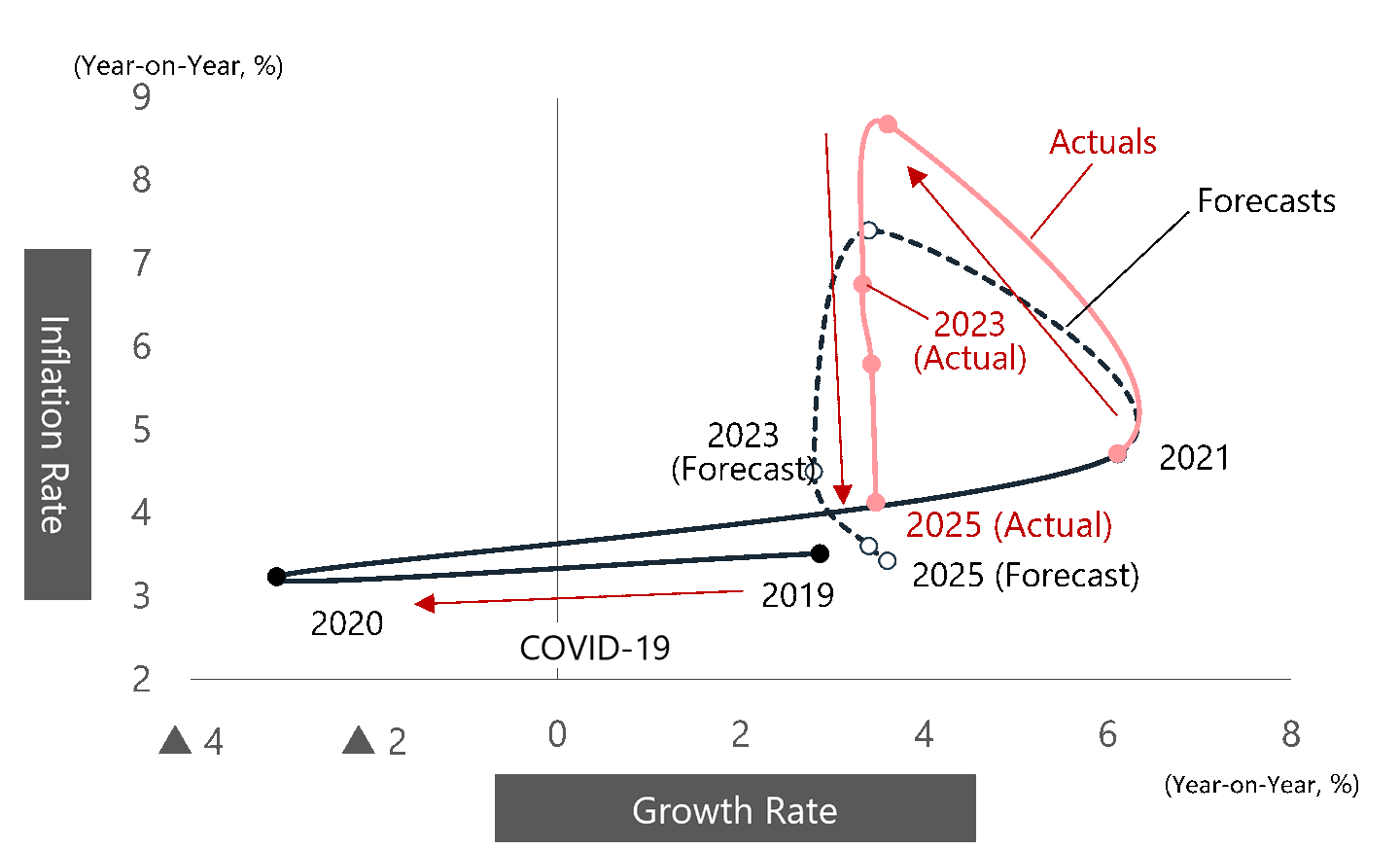
In “World Economic Prospects for 2025,” published in May 2022, HRI presented its outlook for the global economy through 2025 against a backdrop of Russia’s invasion of Ukraine, surging global inflation, and China’s zero-COVID policy. At the time, although the global economy was in a phase of recovery from the COVID-19 pandemic, HRI forecast that “growth would not continue at a steady pace, but would slow after a period of inflation and monetary tightening” (Figure 1: Forecasts).
Source: Prepared by HRI based on IMF data
Figure 1. Forecast and Actual Global GDP Growth and Inflation Rates
Looking back at the global economy since then, inflation rates began to decline in 2023, while the high-interest-rate environment persisted for an extended period, and the Chinese economy also slowed amid factors including problems in the real estate sector. In addition, the prolonged Russia-Ukraine war further underscored the importance of economic security and supply chain resilience. Major trends such as rising geopolitical risks, the reconfiguration of economic blocs, and the restructuring of supply chains have broadly evolved as anticipated (Figure 1: Actuals). At the same time, developments beyond the assumptions made at the time also emerged, including the shift by the U.S. and European central banks toward interest-rate cuts in 2024, greater-than-expected resilience in the U.S. economy driven by the boom in generative AI investment, and disruption to the global economy resulting from tariff policies under the Trump administration.
The report also pointed out that the progress of digitalization and efforts to strengthen supply chain resilience triggered by the pandemic represented “irreversible changes in social and industrial structures.” Since then, the rapid adoption of generative AI, increased corporate investment, and the restructuring of supply chains driven by economic security concerns have continued to advance, with changes in social and industrial structures persisting beyond the business cycle. This once again demonstrates the importance of analyzing not only short-term economic fluctuations but also the direction of medium- to long-term structural changes, even in an environment of high uncertainty.
The conflict between the United States and Israel on one side and Iran on the other broke out in the Middle East in February 2026. This triggered a sharp rise in crude oil prices and disruptions to maritime transportation networks, significantly affecting global supply chains.
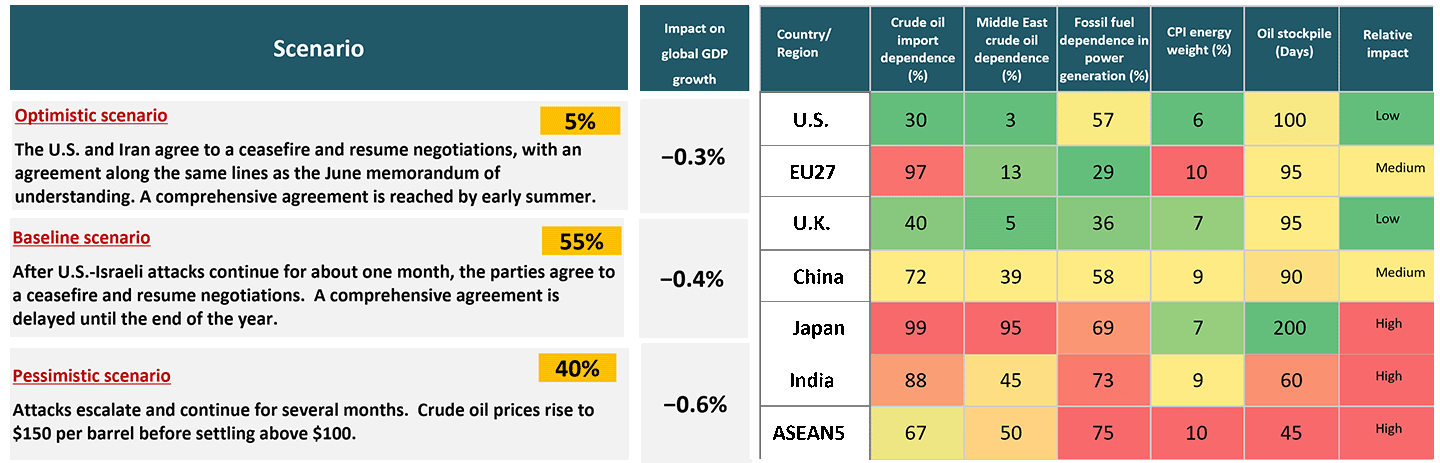
Following the outbreak of the conflict, HRI developed three scenarios based on qualitative information from overseas partner think tanks and experts, among other sources, according to the degree of impact on energy prices and supply chains.
Next, treating these qualitative scenarios as initial shocks, we quantified them using a multivariate vector autoregression (VAR) model and conducted simulations of their impact on GDP. Specifically, parameters such as the magnitude of the increase in crude oil prices were set for each scenario, and estimates were calculated. The analysis went beyond simply measuring the impact on GDP growth rates to also examine effects on supply chains and on global inflation and monetary policy.
The use of a VAR model makes it possible, for example, to objectively test, based on historical data, a chain of effects and transmission channels whereby an increase in energy prices leads to higher inflation, which prompts central banks to raise interest rates, ultimately dampening economic activity.
Note: Scenarios as of July 2026. Impact on global GDP growth is HRI's estimate for 2026.
Source: HRI
Table 1. Scenarios Concerning the Situation in Iran and Their Impact on Each Region
As changes in the economic environment accelerate, economic analysis methods must also evolve from static approaches toward more dynamic and timely ones. At HRI, we are currently pursuing the following three initiatives to improve the efficiency of our analytical processes and the accuracy of our forecasts.
One of the challenges in economic analysis is how to organize and analyze the vast amount of information and economic statistics generated every day, and how to quickly connect these insights to management issues. To address this time-related bottleneck, HRI is developing and progressively implementing “AI Economists” and “AI Analysts” based on frameworks that organize our past research assets, economic theories, and geopolitical risks. By using AI to support routine information gathering and organization, economists can focus more on refining scenarios and conducting deeper analysis.
Macroeconomic analysis requires capturing subtle changes emerging on the ground and in policy-making circles around the world. To this end, HRI plans to further strengthen its collaboration with leading overseas think tanks and experts in Japan and abroad. This will enable us to quickly grasp local developments and policy trends that are difficult to discern from statistical data alone and incorporate them into more robust analyses.
As an in-house think tank, HRI’s strength lies in its ability to combine a macro-level research foundation, including regular quarterly forecasts, with a deep understanding of the micro-level challenges faced by companies at the forefront of their respective industries, and to integrate these perspectives into a coherent story through its unique global network. Going forward, HRI will continue to further strengthen this integration of macro- and micro-level perspectives.
This report has provided a brief overview of HRI’s approach to economic analysis. Economic forecasting and analysis of key issues are among the core functions of a think tank, but the goal is not simply to predict an uncertain future with perfect accuracy. Rather, it is to continuously provide decision-making frameworks that enable organizations to adjust course swiftly and rationally, based on objective data and sound reasoning, when confronted with unexpected external shocks or structural changes.
HRI will continue to update its analytical approaches while integrating qualitative insights from its global network with quantitative analysis conducted internally. Going forward, we will remain focused on our research and analytical activities so that we can provide reliable information that, from an objective and clear-eyed perspective, anticipates developments in the global economy and helps identify the directions in which businesses and society should move.

Kazuhiko Yano
Chief Economist, Global Intelligence and Research Office, Hitachi Research Institute
Engaged in research and analysis of the global economic outlook and geopolitical risks. After working at Mizuho Research Institute and other organizations, he joined HRI in 2019 and has served in his current position since 2021.

Kenichiro Yoshida
Chief Researcher, Global Intelligence and Research Office, Hitachi Research Institute
Engaged in research and analysis of economic and financial developments in the United States and Europe. After graduating from the Faculty of Commerce and Management at Hitotsubashi University, he worked at Mizuho Research Institute, where he subsequently served as Head of its London Office. He has held his current position since 2021. His recent research interests include AI investment trends in the United States and Europe.
Author’s Introduction
Kazuhiko Yano
Chief Economist,
Global Intelligence and Research Office
Kenichiro Yoshida
Chief Researcher,
Global Intelligence and Research Office
We provide you with the latest information on HRI‘s periodicals, such as our journal and economic forecasts, as well as reports, interviews, columns, and other information based on our research activities.
Hitachi Research Institute welcomes questions, consultations, and inquiries related to articles published in the "Hitachi Souken" Journal through our contact form.