Rising correlation between stock and bond markets and the three risks to watch

~ Financial resilience and investment decisions amid heightened WACC volatility ~

    May. 20, 2026

    1. The gradual rise in stock-bond correlation and the decline of diversification benefits

    • Since mid-2025, the correlation between US stocks and long-term Treasury bonds has been strengthening. Figure 1 compares the S&P 500 Index, a representative US stock market index, with the iShares Treasury Bond ETF price, which serves as a proxy for US long-term bond prices. It is evident that the two became more closely correlated from mid‑2025 through early 2026.

    Source: HRI based on data from FRED and iShares

    Figure 1: Trends in U.S. stock price and long-term Treasury bond price
    • The correlation between stocks and bonds is occurring globally, not only in the US but also in Japan and the Eurozone. The simultaneous movement of rising (or falling) stock and bond prices reduces the risk-hedging effect of diversification, impacting the investment decisions of corporations and financial market participants.
    • In a blog published in February 2026, the IMF stated that “Stock-bond diversification has become harder as stocks and bonds tend to move in tandem during sharp selloffs, adding to financial stability concerns” (IMF 2026).

    2. Changes in the global macroeconomic and geopolitical environment behind the increased stock-bond correlation

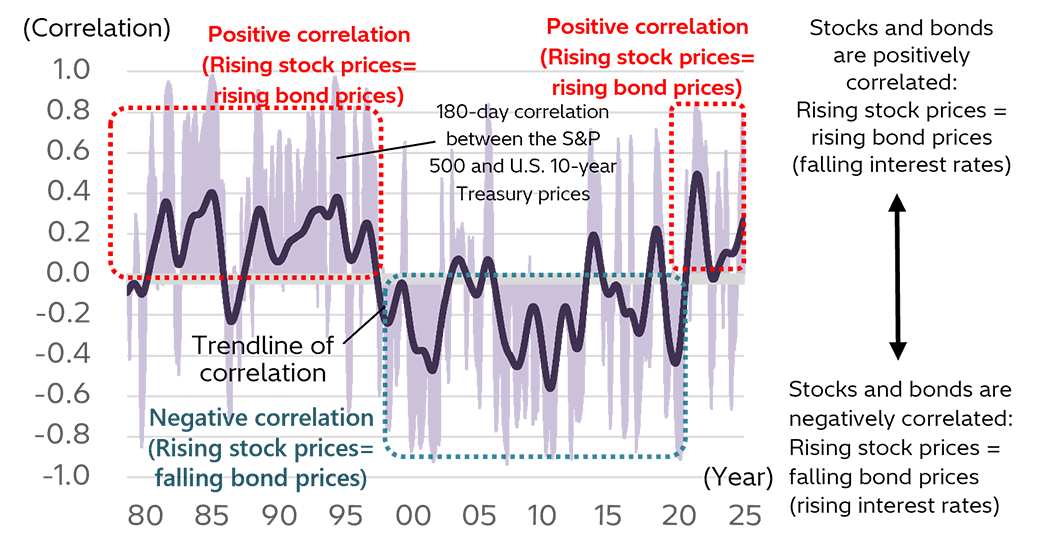
    • Figure 2 illustrates the correlation coefficient of stock and long-term Treasury bond prices since 1980 (ranging from -1 to +1, where +1 indicates a strong positive correlation, -1 a strong negative correlation, and 0 no correlation).

    Note: The correlation coefficient ranges from −1 to +1; +1 indicates a strong positive correlation, −1 indicates a strong negative correlation, and 0 indicates no correlation.
    Source: HRI based on data from CEIC

    Figure 2: Correlation between U.S. stock prices and long-term Treasury bond prices

    • From the 1980s to the mid-1990s, the two generally exhibited a positive correlation (rising stock prices = rising bond prices, falling interest rates). In contrast, from the mid-1990s to around 2020, this shifted into a negative correlation (rising stock prices = falling bond prices, rising interest rates). However, since 2020, stocks and bonds have returned to a positive correlation for the first time in approximately 30 years, and the degree of this positive correlation has gradually strengthened through 2025.
    • The underlying factors for this strengthened correlation since 2020 are shifts in the global macroeconomic and geopolitical environments. In particular, following the COVID-19 pandemic in 2020 and Russia’s invasion of Ukraine in 2022, US inflation rose significantly. This triggered a simultaneous decline in both stock and government bond prices, thereby strengthening their correlation. The Bank for International Settlements (BIS) has also pointed out that inflation has influenced the shift in correlation since 2021 (BIS 2023).
    • Nevertheless, the relationship between stocks and bonds is not determined solely by inflation. For instance, looking back at the 1980s and 90s when a positive correlation was maintained, stagflation did not necessarily occur throughout the entire period. Particularly in the early 90s under Fed Chairman Alan Greenspan, the US saw rising IT stock prices while low inflation drove up bond prices, strengthening the correlation between the two. In this regard, there are similarities with the current AI boom; specifically, in early 2025, the US economy expanded with both stock and bond prices rising, as inflation fell from its previous peak. However, since the beginning of 2026, stocks and bonds have been trending downward simultaneously while remaining correlated.

    3. Cost of capital varies by region and industry: rising stock-bond correlation has become a risk for corporates

    • From a corporate perspective, falling stock and bond prices (rising interest rates) can increase the Weighted Average Cost of Capital (WACC) through a rise in the equity risk premium due to growing future uncertainty and an increase in borrowing rates. As shown in Table 1, WACC varies by region and industry (Damodaran 2026).

    Table 1: WACC by region and industry (2025)
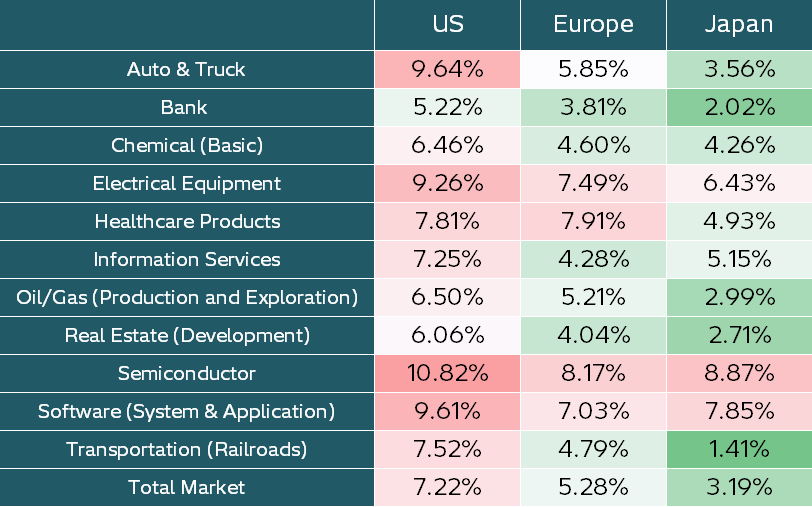
    Note: Cells are shaded in red for higher WACC and green for lower WACC. The analysis is by Professor Aswath Damodaran of New York University's Stern School of Business. The risk-free rate is calculated based on the 10-year Treasury bond yield as of March 2026.
    Source: HRI based on Damodaran (2026)
    • By Region, WACC in the US is high, while WACC in Europe and Japan is relatively lower. The background for this is that the yield on government bonds, which serves as the risk-free rate, is higher in the US.
    • By industry, WACC is relatively low in sectors such as banking, chemical, and rail transportation services, regardless of the region. This is likely due to factors such as stable earnings generated by fixed assets and the existence of regulatory protection.
    • The cost of capital is relatively high for IT and AI-related industries, such as electronics, semiconductors, and software, where stock prices have risen significantly in recent years and volatility is high compared to market fluctuations. This can be described as investment predicated on high returns.
    • Future uncertainty remains high, driven by global inflationary trends, such as the sharp rise in oil prices caused by the situation in Iran, and the future direction of monetary policies in various countries. Especially in phases where the stock-bond correlation is strong, it can become a risk for corporate management from three perspectives—financing, investment, and the external environment—namely: (1) a decline in financial resilience due to rising financial costs for both stocks and bonds, (2) delays in investment decision-making caused by wider fluctuations in WACC, and (3) demand contraction resulting from financial market disruptions.

    End of report

    Source:

    BIS (2023), “The correlation of equity and bond returns”, BIS Quarterly Review: December 4, 2023.

    Damodaran, A.(2026), Damodaran Online, NYU Data history

    IMF (2026), “Stock‑Bond Diversification Offers Less Protection from Market Selloffs”, IMF Blog, February 18, 2026

    Author’s Introduction

    Kenichiro Yoshida

    Chief Researcher, Global Intelligence and Research Office, Hitachi Research Institute

    Engaged in research on economic and financial conditions in the United States and Europe. After graduating from Hitotsubashi University's Faculty of Commerce, he worked at Mizuho Research Institute and served as the Chief Representative of Mizuho Research Institute's London Office before assuming his current position in 2021.

    Author’s Introduction

    Kenichiro Yoshida

    Chief Researcher
    Global Intelligence and Research Office

    We provide you with the latest information on HRI‘s periodicals, such as our journal and economic forecasts, as well as reports, interviews, columns, and other information based on our research activities.

    Hitachi Research Institute welcomes questions, consultations, and inquiries related to articles published in the "Hitachi Souken" Journal through our contact form.