Sep. 29, 2026
The situation in the Middle East is expected to remain uncertain. However, a large-scale escalation is likely to be contained, and oil prices are not expected to experience a prolonged, extreme surge. Supported by robust AI-related investment and demand for semiconductors, the global economy is expected to maintain solid growth. On the other hand, long-term interest rates are rising globally against a backdrop of expansionary fiscal policies, increased bond issuance, and inflation concerns; if this trend goes too far, it could have adverse effects such as curbing investment and putting downward pressure on stock prices. Furthermore, there is a risk that stagflation could be triggered by temporary corrections resulting from a reversal in semiconductor and AI-related trading, rising food prices due to extreme weather, high energy prices caused by deteriorating conditions in the Middle East, and the resulting monetary tightening. Global real GDP growth is projected to be 3.1% in 2026 and 3.2% in 2027.
The U.S. economy continues to maintain resilient growth, supported by expanding business investment backed by strong AI-related demand. The expansion led by investment in data centers, servers, and other equipment is expected to continue in 2026, but investment costs are rising as prices of AI-related goods increase. In response to rising inflation, the Fed raised its policy rate by 0.25 percentage points at the September 2026 FOMC meeting, and we expect the Fed to raise rates again by the end of 2026. Further increases in interest rates, including higher Treasury yields, would restrain investment and consumption. Issues surrounding AI investment, including opposition from local residents to data center construction, are also beginning to emerge and pose risks going forward. Real GDP growth is projected at 2.1% in 2026 and 2.1% in 2027.
The euro area economy is recovering gradually, supported by expanding defense spending and infrastructure investment. However, the economy is likely to slow in the second half of 2026 due to persistently high energy prices amid continued instability in the Middle East and higher electricity prices resulting from heatwaves. With inflation concerns rising, we expect the ECB to raise rates by an additional 0.25 percentage points by the end of 2026. In the UK, construction investment is supporting the economy, but employment and income conditions are deteriorating, and the economy is expected to slow. As inflation remains above the central bank’s target, we expect the BOE to shift toward rate hikes. Real GDP growth is projected at 0.9% for the euro area in 2026 and 1.2% in 2027, and at 1.2% for the UK in 2026 and 1.0% in 2027.
The Chinese economy continues to slow. Exports—particularly to ASEAN countries—are showing robust growth in sectors such as semiconductors and transportation equipment; domestically, this is driving profit growth in new manufacturing sectors, including AI and IT. On the other hand, profit growth in traditional manufacturing sectors has stagnated, and profitability is deteriorating due to intense domestic competition. Although the government plans to increase investment in energy and data processing infrastructure over the medium term, overall investment is expected to remain sluggish. Due in part to financial difficulties faced by local governments, the real estate inventory adjustment is expected to be protracted. Consumption remains subdued due to a decline in disposable income. Real GDP growth is projected at 4.2% in 2026 and 4.0% in 2027.
The Japanese economy continues to show a resilient recovery, supported by the release of crude oil reserves and diversified procurement. Going forward, while the inflation rate is expected to rise temporarily to around 3%, creating headwinds for domestic demand, AI-related demand—driven primarily by rising prices—will underpin corporate earnings, and the economy is expected to remain resilient. We expect the Bank of Japan to accelerate its pace of interest rate hikes to once per quarter. A key risk to watch is a “Japan sell-off,” where further interest rate hikes—driven by concerns over funding sources for measures such as a consumption tax cut—could destabilize the financial system. Real GDP growth is projected at 0.9% in calendar 2026 (0.9% in fiscal year terms) and 0.7% in 2027 (0.8% in fiscal year terms).
India continues to be driven by domestic demand, led by investment and consumption, while external demand is also increasing, supported by stronger exports to the U.S. following a de facto reduction in U.S. tariff rates. Although caution is warranted regarding rising food prices and renewed inflationary pressures stemming from extreme weather, India’s growth rate is expected to remain strong at 6.4% in FY2026 and 6.5% in FY2027. In the APAC region, Taiwan is projected to achieve double-digit growth in FY2026, driven by strong semiconductor exports. Growth in ASEAN varies by country, but the ASEAN-5 as a whole is projected to grow in the high 4% range, at 4.7% in 2026 and 4.8% in 2027.
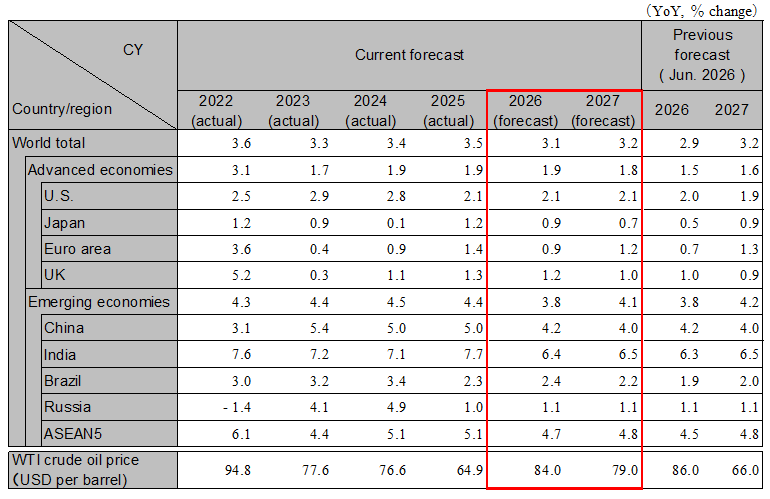
Note: Values for Japan differ from those shown in the table below on a fiscal-year basis because they are on a calendar-year basis. India’s figures are shown on a fiscal-year basis. ASEAN5 is comprised of Indonesia, Thailand, Malaysia, the Philippines, and Vietnam.
Source: Actual figures are from the IMF, forecasts are from the IMF (Brazil and Russia), and Hitachi Research Institute
(others)
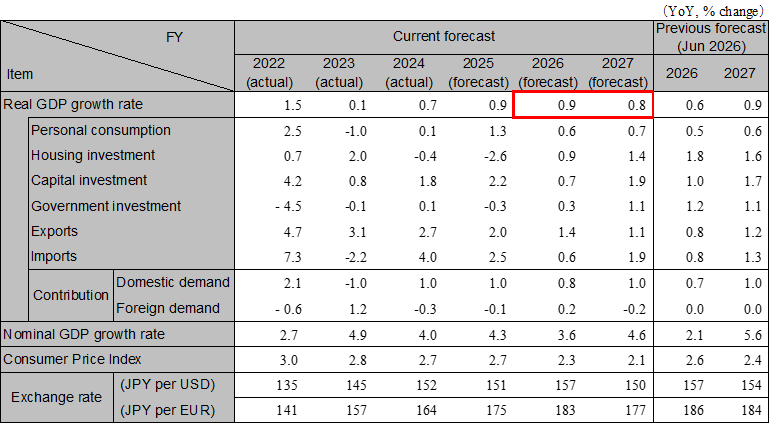
Note: The individual numbers and their sum may not match due to fractional processing.
Source: Cabinet Office, forecasts by Hitachi Research Institute
We provide you with the latest information on HRI‘s periodicals, such as our journal and economic forecasts, as well as reports, interviews, columns, and other information based on our research activities.
Hitachi Research Institute welcomes questions, consultations, and inquiries related to articles published in the "Hitachi Souken" Journal through our contact form.